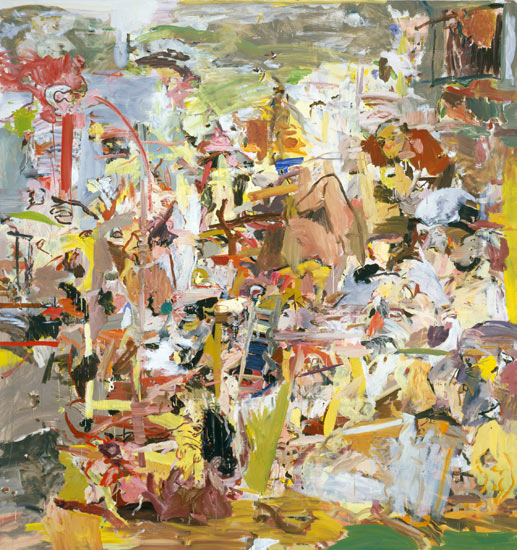
Thanks, Roody Hooster by Cecily Brown (oil on linen, 2004) Photograph: PR
Thanks to my friend at Undercover Painter for finding and pointing this out to me. It's a great interview and says so much about the artistic process that I couldn't not post it here. (I'm also a BIG fan of her work - see it here)
The boundaries of painting excite me. You've got the same old materials - just oils and a canvas - and you're trying to do something that's been done for centuries. And yet, within those limits, you have to make something new or exciting for yourself as well as other people.
I have always wanted to make paintings that are impossible to walk past, paintings that grab and hold your attention. The more you look at them, the more satisfying they become for the viewer. The more time you give to the painting, the more you get back.
I often avoid using the terms figuration and abstraction because I've always tried to have it both ways. I want the experience of looking at one of my paintings to be similar to the process of making the painting - you go from the big picture to something very intense and detailed, and then back again.
The viewer is a living, breathing being that moves about in space and I want the painting to be experienced like that. I want my painting to imitate life in that way. I want the experience of looking at it to be very much like the experience of walking through the world.
My process is really quite organic and starting a painting is one of the best parts for me. I always start in quite a loose and free way. I often put down one ground colour to begin with and then play off that. For the first day or two, everything moves very quickly - sometimes almost too quickly - then there's often this very protracted middle period of moving things around, changing things, editing.
Often, I find it really hard to see what I'm doing when I'm in the thick of things. I can get too precious and have to force myself to put my paintings aside. There's a wall in my studio where I hang paintings that I think are done or nearly done. Over time, I'll realise which ones are working and which aren't.
There's never a moment for me when I consciously add the last stroke. When a painting is 90-95% there, it's especially difficult because you know that it's really close and you also know that you could completely ruin it. Of course, I do often ruin things. I take things too far, and can't get them back ...
The problems don't get any easier just because you're exhibiting. I'm still faced with the same difficulties as when I first started to paint. But you'd never make a mark if you started worrying too much about how it will be received in the world, or if anyone is going to look at it. You can't have all that in your head while you're in the process of making a painting.
I think once I stopped caring quite so much about where I fitted in, and whether it made any sense to be painting, I started getting more and more absorbed in it. I've discovered that the more I paint, the more I want to paint. The longer I go on doing it, the more I have to say and do. You pose a certain set of questions in one group of paintings and you want to answer them in the next. One body of work leads naturally to the next - you sort of feed off yourself. It's a question of accepting the limits of painting and trying to be as imaginative and expansive as possible within those boundaries.
• Cecily Brown is represented by Gagosian


