"It is not the eye, it is the mind which the painter of genius wishes to address; nor will he waste a moment upon those smaller objects which only serve to catch the sense, to divide the attention, and to counteract his great design of speaking to the heart". Joshua ReynoldsTrips, Tips, Trials, Tribulations, Triumphs, Talks with, and Tributes to artists by Sydney Based, Professional Contemporary Abstract Landscape painter. www.gabriellejones.com.au
Friday, October 30, 2009
Misc Quotes relating to art
"It is not the eye, it is the mind which the painter of genius wishes to address; nor will he waste a moment upon those smaller objects which only serve to catch the sense, to divide the attention, and to counteract his great design of speaking to the heart". Joshua ReynoldsWednesday, October 28, 2009
What I do when I'm not painting -You Tube, I love you
Monday, October 26, 2009
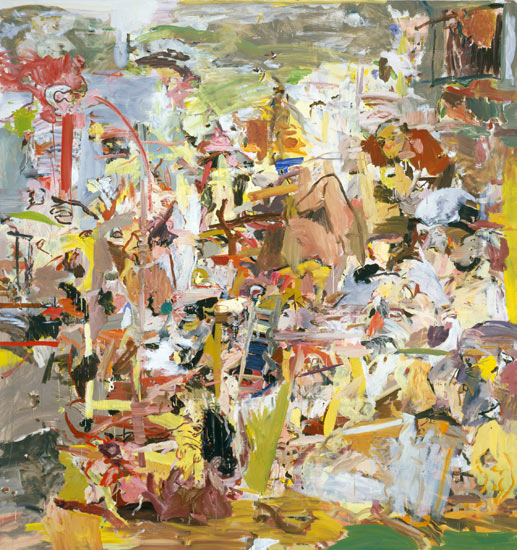
Cecily Brown -Interview by Perri Lewis, the Observer (20/9/09)
Thanks to my friend at Undercover Painter for finding and pointing this out to me. It's a great interview and says so much about the artistic process that I couldn't not post it here. (I'm also a BIG fan of her work - see it here)
The boundaries of painting excite me. You've got the same old materials - just oils and a canvas - and you're trying to do something that's been done for centuries. And yet, within those limits, you have to make something new or exciting for yourself as well as other people.
I have always wanted to make paintings that are impossible to walk past, paintings that grab and hold your attention. The more you look at them, the more satisfying they become for the viewer. The more time you give to the painting, the more you get back.
I often avoid using the terms figuration and abstraction because I've always tried to have it both ways. I want the experience of looking at one of my paintings to be similar to the process of making the painting - you go from the big picture to something very intense and detailed, and then back again.
The viewer is a living, breathing being that moves about in space and I want the painting to be experienced like that. I want my painting to imitate life in that way. I want the experience of looking at it to be very much like the experience of walking through the world.
My process is really quite organic and starting a painting is one of the best parts for me. I always start in quite a loose and free way. I often put down one ground colour to begin with and then play off that. For the first day or two, everything moves very quickly - sometimes almost too quickly - then there's often this very protracted middle period of moving things around, changing things, editing.
Often, I find it really hard to see what I'm doing when I'm in the thick of things. I can get too precious and have to force myself to put my paintings aside. There's a wall in my studio where I hang paintings that I think are done or nearly done. Over time, I'll realise which ones are working and which aren't.
There's never a moment for me when I consciously add the last stroke. When a painting is 90-95% there, it's especially difficult because you know that it's really close and you also know that you could completely ruin it. Of course, I do often ruin things. I take things too far, and can't get them back ...
The problems don't get any easier just because you're exhibiting. I'm still faced with the same difficulties as when I first started to paint. But you'd never make a mark if you started worrying too much about how it will be received in the world, or if anyone is going to look at it. You can't have all that in your head while you're in the process of making a painting.
I think once I stopped caring quite so much about where I fitted in, and whether it made any sense to be painting, I started getting more and more absorbed in it. I've discovered that the more I paint, the more I want to paint. The longer I go on doing it, the more I have to say and do. You pose a certain set of questions in one group of paintings and you want to answer them in the next. One body of work leads naturally to the next - you sort of feed off yourself. It's a question of accepting the limits of painting and trying to be as imaginative and expansive as possible within those boundaries.
• Cecily Brown is represented by Gagosian
Saturday, October 24, 2009
Professional Practice part 11
Final Instalment to common questions re my professional practice. How important is your studio space to the work you produce?
Very important, but less so as I gain more skills and confidence (apart from the fact that I need one to do the work- how it is set up and where it is becomes less important to me). It was important for me to invest in myself as an artist - I spent the first year or two after graduation painting from a garage - as many artists do. I went to Bundanon and had all this space. I still didn't think I could afford it, and one of the other artists quoted someone famous (de Kooning???) who said, "when you can't afford a studio, rent two!). It's a statement to the world that you are serious (but only good if you turn up to it! -there are many studios waiting for their owner day in and day out....). The financial commitment means you may be more likely to actually do the work - otherwise it's an expensive accoutrement!
As for the way it is set up - it's important to have ventilation, considerate neighbours, and a re-inforceable policy by the owners that protects the environment; and that, preferably, non-toxic chemicals or odourless solvents only be used. A dream, but worth fighting for! I can't work if people are splashing turps around (too many years of not worrying about the chemicals - it builds up!) A good studio complex is also worth it as the energy generated by happy, working, creative artists is palpable and contagious!
How important is your studio space? What do you think are important considerations when choosing a studio? Post your comments and ask any questions here
Image; Gabrielle Jones Stand 2009 Oil on Canvas 30 x 30cm
Wednesday, October 21, 2009
Inspiration-Alex Perry & Designer Rugs

A lovely man called Cedric, an arts patron, invited me to the launch of the Alex Perry Designer Rugs collection last night. It was held in a groovy studio space in Alexandria and there were a number of celebrities, models and "all-round" beautiful people there - and then there was me!
Monday, October 19, 2009
Vale Fred Cress

Fred Cress, the iconic Australian Artist, was cremated yesterday after losing his long battle with cancer last Wednesday, 14th October. The celebration of Fred's seventy one years was attended by hundreds of friends and fellow artists whose lives had been made more interesting, if not better, by this generous entertainer, wonderful guitarist and music enthusiast. By all accounts, was a great friend who loved a secret and a beautiful woman (preferably blonde).
Duke Gold Coast Art Prize

Sunday, October 18, 2009
More Quotes - On Artistic Process II

“You have to reduce in order to be clear.” Luc Tuymans
“Art proves itself in the making…I don’t want to see the world in any personal way. I have no aesthetic problem and the technique of making is immaterial. There’s no distinction between paintings, and I would like to change my methods as often as appropriate.” Gerhard Richter
“The physicality of the painting is important, whereas I don’t think the depiction of psychological states can give the same impact, the same strangeness, the same directness – or indirectness”. Luc Tuymans
“Certainty is the less safe option” Gerhard Richter
“When you are in front of a painting, you’re in front of the place where whoever made that work was, and you see the process of the making…” Jenny Saville
“You realise that you can’t represent reality at all – that what you make represents nothing but itself, and therefore, is itself reality….I’m not trying to imitate a photograph, I’m trying to make one.” Gerhard Richter
Image: Gabrielle Jones, "Sofala" 2008 Oil on Canvas 110x 83cm
Thursday, October 15, 2009
Guy Maestri- Google Earth

Attended the very crowded opening of this, Guy's first exhibition since winning the Archibald Prize with a painting of blind Indigenous singer Geoffrey Garrumul Yunipingu. I must concur with the oft repeated comment of the night, "this guy's got balls!" Maestri has done a total about face from his commercially successful, colourist, lyrical gestural landscapes, reminiscent of Cy Twombly, to monotone, realist, photography-based art which almost belies the “touch of the hand”. What continues is the concern with ecology and the landscape, enhanced in this show by a theme of human folly.
The unkind (and probably jealous) have speculated that Guy won the Archibald by changing his style, then thought he would/should capitalise on that in his next show. Do the maths! The number of paintings and cohesive quality and theme suggests he was painting in this style well before he entered the Archibald. Even if they’re right, he’s still a prodigiously talented, thoughtful artist because he could whip up such a show in a painfully short seven months since the prize announcement.
It doesn’t matter. What matters is on the wall – and that an artist made a choice to risk his “Brand” and his sales from followers, and go where he needed/wanted to go, to keep his practice alive and mentally energizing. What authentic artist really wants to keep painting the same thing? And isn’t a refusal to “play it safe” one of the characteristics that History has taught us is essential for creativity and great art practice itself?
Musings aside, the exhibition has a powerful, yet dream-like quality that sees a 60’s Astronaut standing on a crashing wave; a deep sea diver floating in a human chest; and boxing kangaroos obliterated by a slash of muddy, angry paint. My favourite was “Untitled, 2009”, a beautifully rendered though flattened (tenderized??) calf floating in infinity, with the bright yellow meat tag attached to its ear optically jumping from the painting. This was closely rivaled, in my estimation, by Trophy I, the head of an antelope(?) mounted in space in a frontal view that evokes it’s death by hunter and starkly contrasts in its beauty with the ridiculousness of placing animal heads in loungerooms as a measure of gamesmanship, skill or machismo.
The work still shows elements of Guy’s previous exhibitions’ risky execution – much of the paint surface is attacked by solvent or mediums to blister the otherwise smooth, varnished finish. But somehow, corrupted surfaces and slashing paint included, the images display a cold, removed beauty that nevertheless enigmatically draws the viewer in, leaving an image to be ruminated upon, in its quiet acceptance of death and new worlds past, present and future.
Tim Olsen Gallery 63 Jersey Rd Woollahra 13th October - to November 1st
Images: Guy Maestri, Untitled, 2009 183 x 152cm
Tuesday, October 13, 2009
Peter Godwin-Defiance Gallery

This is the third show of Peter Godwin's I have had the pleasure of seeing. If you don't know his work, then you can't be anywhere in Sydney around artists, who seem to be all singing his praises.