Thursday, May 12, 2011

Day 9: A day walk in the M'goun Valley

Drumming in the evening - an influence of Arabic and Berber traditional songs, along with poetry.

The Kasbah we walked to

Spectacular views along the way


Doctor Berber - La'Hassim

Poppy fields also line the valley and we walked through a number of Berber villages. These people of the High Atlas Mountains were the fierce resistance against the French colonisers and are still very protective of their culture and land.

Cheeky berber boys can now count to five in English

A lone Female strikes a pose

Boys walk the alley ways behind the tall walls of the village


Causing a riot in the store - buying lollies


We explored this beautiful area, trekking a 10km circuit that took about 4 hours, under the guidance of La’Hassim, a member of the family that owns the Gite D’Atape where we are staying. Our party down to two after about one area, we walked past Berber villages -red slammed-earth buildings camouflaged into the hillsides with an occasional, astoundingly coloured door. The mosque marks the approach to another village, and some of the houses are very well cared for, with gardens in front and straight fences. Our guide even proudly pointed out one which had wooden windows and was made of very well constructed bricks.

The highlight was meeting Berber children and the occasional adult, along the way, greeting them with “salam alicom” (at least, that’s how I pronounced the Berber for Hello). I had packed some dates for the trek but found that giving them away to the kids was much more enjoyable. And may I say, there are a few more children in the Berber villages that know how to “high Five” and count to five in English now, because of my urge to play with them. The girls are very shy from a concerningly young age, having been taught already, in this very religiously conservative area, that they should not draw attention to themselves. I did, however, catch one of them who smiled happily for the camera and I nearly started a riot when I asked La’Hassim to buy some “bon bons” for the children at the village “Alimentar”.

Throughout the trek, it was patently obvious that the women of the area work very hard, washing clothes in the river, fetching alfalfa for the animals and carrying it in large sacks on their backs, tending to the crops, cooking the meals and keeping the interior of their homes clean and tidy. When I asked what the men do, Atika, our guide, said that they shop once a week for the family….. Apparently, they decide all purchases, including what the women will wear. They hold the money, and the power.

The walk also included the famous Rose Valley, a rich, cultivated area which borders the river flowing from the Atlas Mountains, where “Grain” (wheat) onion, carrot, potato and broad beans (the Berber staples) are grown in small family owned plots. This valley also has wild “damacien” roses growing along the river, providing a truly sensational setting for a long trek. The roses have a distinctive perfume and are harvested for rose water and for the paste used in the Hammam, among other applications.

Another highlight of the day was trying to communicate with La’Hassim, who speaks French, Berber, Arabic, a little Spanish and no English. I know a few French words, a few Italian and Spanish words and I learnt from him a few Berber words, and some Arabic – woah! One language at a time! He gave me the names for river, good, bad, wheat, thank you, and many others I will never remember. And somehow I found out that his pronounced limp – one leg is about 4-6inches shorter than the other and he walks constantly on his toes on this leg, whilst his back swivels around to carry this leg forward- was caused by a fall from a terrace in the mosque. I assume he was not able to get proper medical attention or to get it in time. It causes him pain in his leg and a lot of pain in his lower back, but still he manages to lead this trek! He also managed to apply a “muy intelligente” Berber trick to my foot that was giving me trouble due to an ill-fitting shoe, (no comparison in the pain compared to his, I am sure) so that I was able to finish the trek in relative comfort. “Doctor Berber” is now his nick-name.

We returned to a lunch of Berber Omelette – containing the locally grown vegetables and one egg, mixed with Moroccan spices and cooked in a Tagine dish and very tasty, accompanied by the wonderful freshly squeezed orange juice that is a staple of Morocco. A short siesta followed and an afternoon of drawing this amazing “Panoramique”.

We then had dinner, and a wonderful display of drumming from all the family - apparently all cousins, no brothers, but I can't see how this is possible. However, a great family likeness and all handsome - what's a girl to do? We danced and I was asked to sing, so fortified with a couple of beers (ONLY! I Promise) I sand "father and Son" as Yusef Islam (alias cat Stevens) is due to perform in Rabat in a week or two, so the locals know some of his work. Anyway, the night finished with logic tricks (the kind I used to play in the pub after work with the Engineers) and so , despite the language barrier in the instructions, I solved two of the puzzles to great surprise from the berbers. I had to prove that women are smart, so tried particularly hard. This was one of the highlights of the trip, amongst very generous, very funny , very musical and very beautiful people.

Day 8: Todra Gorge-Dades Valley-M'goun Valley

Again, Spectacular Scenery Lines the Route.


We passed many towns and kasbahs along the route. Most of these, in Berber Country, are made of Mud and lime, with grain as a strengthener, and blend into the mostly rocky countryside.

Todra Gorge itself - complete with father and son commuting by donkey

It seems to be the men who are most interested in fertility -
or perhaps, its another "-ility" word?


One of the towns we passed through and stopped for water. Colour is a by word for Morocco.

The friendly camel herder, come Berber drummer. So special...

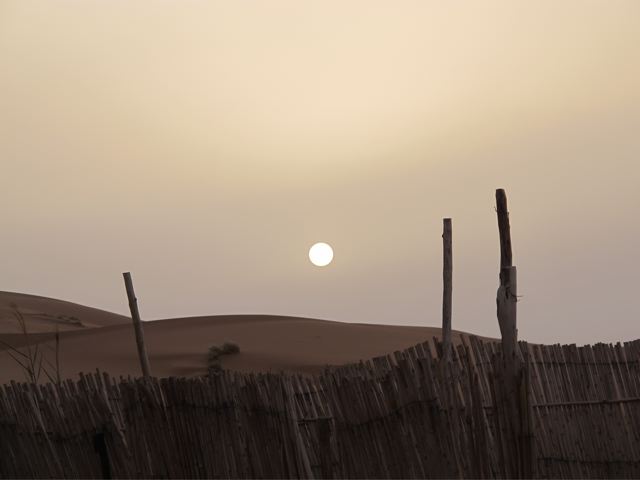
Sun rise over the sand dunes.

Climbed the hill only half way this time to enjoy a further sunrise ride –which looked a little more like a moon rise and happened whilst we were looking elsewhere- but still wonderful to be up at this part of the day (Unusual!) before we return to our Auberge. A quick reviving breakfast, consisting of mostly jams and strong coffee, and it was off towards Todra Gorge, a massive trench that rises over 250 metres and one of the most dramatic natural sights in Morocco. We took a short walk in the area, where the locals come to swim in the shallow stream and take water from the waterfall which, in local lore, guarantees fertility (and it was surrounded by men, only!) A lunch of beef kebabs and “frites” (fries) hit the spot – but the Berber omelette looked and tasted better – damn!- before continuing to the beautiful Dades Valley, where we stopped for a break, and to take some photos of the remarkable scenery and continue our journey. We arrived in the M'goun valley and spent the night in a Berber house. The walls are made from rammed earth and what looks like straw, and there are geometric symbols carved out of them, with roof panels of what looks like bamboo stems, also laid out in geometric patters, The view from the window made me a very happy chappy - up the road, women carry bundles of grass to be dried for animal feed, on their backs in large wrap around cloths; the local area bus unloads way too many youths to fit in such a small vehicle, after they have enjoyed a day out; while the children don sticks like those the world over and play for hours. And all this to a back drop of spectacular – and you have to see it to believe it – red rocky mountain ranges, seemingly close enough to touch but in actual fact, miles away.

Dinner on the terrace, surrounded by the red stone, monumental mountains and served by – well, lets face it, beautiful local youths (who could, in fact score modeling contracts in places like Italy with the right gear, if only they could be found out here) meant that the views all round were wonderful and a great day capped finishes on a high note.

Tuesday, May 10, 2011

Day 7: Midelt and the Sahara

Drumming around the campfire.

The camp as viewed from the top of the sand dune I climbed

The sunset - a very special moment for Mothers Day in the Sahara

The view from the sand dune

One perfect dune!

Inside the Berber Tent. I slept half the night under the stars.

Our camp - The attendants slept in a similar camp nearby. The real deal! (except there were western toilets. Fair's Fair - it is a holiday!


The Camel Train - I'm on the last one

Our helpful attendants watch us mount these bloody uncomfortable animals! I still have bruises....
The train outside out hotel - awaiting the 1.5 hour trek

View from the hotel terrace - not bad! The camp is for the hotel staff - they really live in these things!


A donkey to market!

The Oasis

Spectacular Scenery - the dam


Today there was a long drive to reach Merzouga, where we dropped off our gear at a simple Auberge, drank mint tea and talked to some of the other group who mirror our tour, and then rode camels into the edge of the Sahara Desert, staying in the Erig reason in a real berber tent and compound. We enjoyed a spectacular sunset after a heart rending, calf muscle screaming hike up a very steep sand dune – to sit in awe and silence at the very tip of the highest dune around. The camp looked like a small jigsaw puzzle from this height, the grazing animals of other Berber compounds only specs on the desert floor. The dunes are stunning, especially at this time of the day, and the camping under a thousand stars, whilst being served a hearty tangine for dinner and, later, entertained by beautiful Berber boys/camel drivers on bongo-like drums was one of the highlights of the tour so far. I as invited to join in on the drums, playing in rhythm with the sounds of berber music, and acquitted myself admirably, such that later, we jammed in a rather strange English/Arabic rap type session whereby I defended the honour our female guide against a (jesting) suggestion that she share the other group’s (male) guide’s tent. I then slept half the night under the stars, something I have never done before, (The sand and lighning eventually drove me into the allocated tent to sleep soundly until an early morning wake up call)

Day 6: From Fes-Midelt

The first sighting of a Midelt Berber - at our hotel! How touristy (but he is a real Berber!)

Colourful shops at a small town along the road from Fes to Midelt. The weather was getting decidedly cooler.

Carcasses hang outside shops in this town known for its kebab/barbecue cooking.
Not much else seems to happen here.

Spectacular alpine scenery and our first glimpse of Moroccan snow

The rock formations in Morocco have to be seen to be believed! There are many colours from gray to green to red.

We stopped for a picnic at a trout fishermen's paradise -and we liked it, too! We bought French brie on long white w\loafes, fresh dates and tomatoes -perfect! - at our first "French-style" supermarket experience

There are many colourful wildflowers along the road - the yellow and purples were my favourite. Scenery changes at almost every bend, and you find yourself anticipating the next "wow!" moment.

A curious Barbury ape.


The Ski town of Ifrane - the local private American Boarding school means that the helicopter pad is kept busy during the term break, so the parents can fit in a little skiing with their offspring!


Leaving Fes we drove south, passing through a variety of spectacular scenery as we made our way towards Midelt. We stopped to in the ski town of Ifrane for coffee, and to see the Barbury apes who live in the forrest but are fairly used to tourist hand outs. We happened upon a small town where kebab was the specialty, with carcasses hanging in the open air from butchers hooks along the streetside kiosks (including a goat which still held on to its head) and the scent of wood-fired meat tantalizing the senses. Midelt is a smallish market town, nestled between the Atlas and Anti-Atlas Mountains, at an elevation of just over 1500m. It’s a perfect spot to break the journey to the Sahara, being a great base for some easy walks. Many of the locals are Berber, and the surrounding countryside is beautiful. After lunch, we stretched our legs for a few hours on an easy hike in the nearby hills of the Merran Gorge, where the locals were extremely friendly and obliging this camera happy trekker with free photos (most Moroccans seem camera shy; if not, we need to pay them 1 -5 Dirhams (approx 1/10 -1/2 cent) depending on their ability to make us feel guilty). Their homes are stacked on top of each other and the hills, and camouflaged, and the washing drying on the rocks of a steep gorge made for colourful shots against a mainly yellow ochre background. More than a few donkey photos, and lone cycler shots were taken, along with photos of curious adolescent girls, sunning themselves on rooftop terraces amongst the satellite dishes (the cost of one dish and wiring is relatively cheap, there are over 200 channels available, and subsequent dishes are free – so the locals everywhere, even in the most remote areas, seem to take exceptional advantage of this). Another wonderful day and a great breakfast followed.

LinkWithin

Related Posts Plugin for WordPress, Blogger...